Ecom Spy Tools Explained (2026): Ad, Store & Product Spy
Ecom spy tools explained for 2026. See what ad, store and product spy tools show, which ones suit your store, what they cost and how to use them together.
Ben · · 9 min read
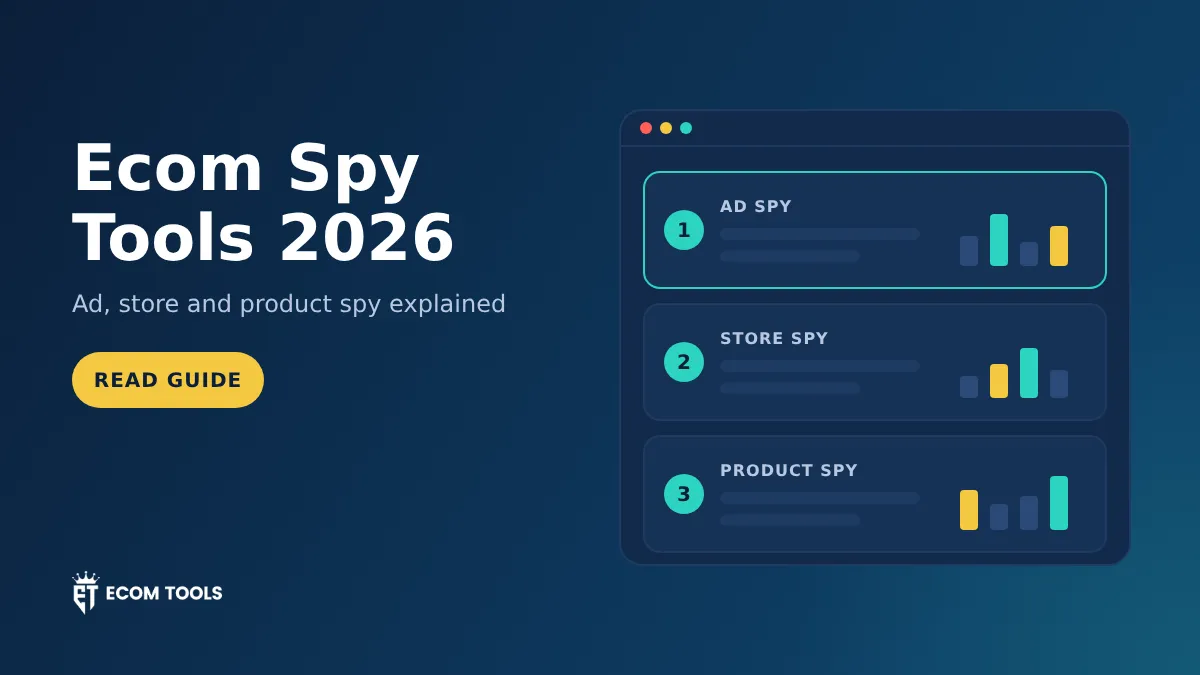
Ecom spy tools let you see what other stores sell, which ads they pay to run and how well their products are doing, so you can test ideas that already have some proof behind them. Most sellers lump every spy tool together, but they fall into three types that answer different questions. Pick the wrong type and you pay for data you never open.
What ecom spy tools actually show you
Every spy tool works from public signals. Ads that are live on Meta or TikTok, product pages on Shopify stores, sales ranks on Amazon and order counts on AliExpress and TikTok Shop are visible to anyone who looks. The tool collects those signals at scale, adds filters and puts them in one place, so you do not spend three hours scrolling the Facebook Ad Library by hand.
Treat what you see as evidence with gaps. A tool can tell you an ad has run for 40 days and picked up thousands of likes, or that a store added a product last week and its estimated sales jumped. It cannot tell you the advertiser's profit, their refund rate or what they paid per sale. Revenue and sales figures on store and product tools are estimates built from things like inventory changes and review counts, and they can be off by a wide margin.
That is why it helps to think in three groups. Ad spy tools show what sellers are paying to promote. Store spy tools show what one specific competitor sells and how it is going. Product spy tools show what is selling across a whole marketplace, whoever is selling it.
The three types of ecom spy tools side by side
The table below is the simplest way to see which group fits the question you are trying to answer. The last column lists the tools in each group that come with an Ecom Tools subscription.
| Type | Question it answers | Data it reads | Included picks |
|---|---|---|---|
| Ad spy | Which ads are sellers paying to keep running | Meta, Instagram and TikTok ads, likes, comments, run time | Adspy, Pipiads, Dropispy, Foreplay |
| Store spy | What is this competitor selling and is it working | Shopify catalogues, new launches, estimated sales | Shophunter, Trendtrack, Dropship.io |
| Product spy | What is selling across the market right now | AliExpress, Amazon, eBay and TikTok Shop sales data | Sell the Trend, Zikanalytics, Kalodata, Fastmoss |
Most sellers need one type first, not all three. The rest of this post covers each group in turn, then how to chain them together when you want to check a product from every angle.
Ad spy tools show what sellers pay to promote
Ad spy is the oldest group and still the one most dropshippers start with. The logic is simple. Nobody keeps paying for an ad that loses money, so an ad that has run for weeks, or that a store keeps duplicating with fresh creatives, is a decent sign the product sells. You search by keyword, niche, platform or landing page, then sort by run time, likes or first seen date.
Adspy is the long-running pick for Facebook and Instagram. Its database is huge, and you can search inside ad text, comments and landing page URLs, which helps when you know a product but not who sells it. The interface feels dated, and on its own it costs about $149 a month, a figure we took from a 2026 third-party review. Pipiads is the TikTok specialist, with filters for ad type, likes, engagement and the store behind each ad. We walk through it step by step in How to Use Pipiads to Find Winning TikTok Products.
Dropispy is a lighter and cheaper Facebook ad spy, listed at around $29.99 a month in one comparison we found. Foreplay works more like a swipe file. You save ads you like into boards and use them as references when you brief your own creatives, which makes it more useful for the video side than for product hunting.
Where ad spy falls short is context. A high like count can come from a giveaway, and a long-running ad can belong to a brand that profits on repeat orders you will never get. Check the store behind the ad before you copy anything. Choose ad spy first if you run paid traffic and your main problem is finding products and angles that already work on Meta or TikTok.
Get Adspy Without the $149/mo Bill
Ecom Tools includes Adspy plus Pipiads, Kalodata, Helium 10, Semrush, ChatGPT Plus and 75+ more, in one dashboard, from $29.95/month.
See Plans & Pricing →
⭐ 5.0/5 on Whop · 11,800+ Discord members · Cancel anytime
Store spy tools show what a competitor sells
Store spy tools start from a store rather than an ad. You add a Shopify store you want to watch, and the tool tracks its catalogue, new launches, price changes and estimated sales over time. Some also show the theme and apps a store uses, which is handy when you are building your own.
Shophunter is built around this job. It tracks Shopify stores and products, flags fast movers and lets you filter by niche, launch date and estimated sales, so you can spot a product that took off in the last fortnight. Trendtrack combines store tracking with ad data, so you see a store's estimated revenue next to the Meta ads it is running, and it comes with the Lifetime plan of Ecom Tools. Dropship.io has a large database of Shopify stores and products plus a sales tracker that watches the stores you pick day by day.
There is also a free option. Koala Inspector is a Chrome extension that shows a store's best sellers, theme and apps right from the store page. It is not part of the bundle and it does not need to be, since it costs nothing and does one small job well.
The weak spot is the numbers. Sales figures on store trackers are estimates, and stores with many variants or heavy discounts can throw them off. Use them to compare stores against each other and to spot changes, not to forecast your own revenue. Choose store spy first if you already know who your competitors are and want to watch what they launch.
Product spy tools show what sells across a marketplace
Product spy tools ignore individual sellers and read marketplace data instead. They show which items are gaining orders on AliExpress, climbing the ranks on Amazon or eBay, or selling on TikTok Shop, often with charts that show whether demand is rising or fading.
Sell the Trend is the general dropshipping pick. Its Nexus section ranks AliExpress and Amazon products by momentum, and store intelligence and a store builder are bolted on. Third-party reviews put its plans anywhere from about $29.97 to $299.97 a month depending on the tier. Zikanalytics is the one for eBay and Amazon sellers, with competitor research by seller name and by category.
For TikTok Shop, Kalodata and Fastmoss read shop, product, creator and video sales data. Kalodata is easier to start with, Fastmoss goes deeper and keeps more history. We compared the two in Kalodata vs Fastmoss if you are choosing between them.
Product data is broad but shallow. You learn that a product sells, but not which angle, ad or price point made it sell, so you still need to look at the ads and stores behind it. Choose product spy first if you sell on a marketplace, or if you want a pool of ideas before you settle on a niche.
How to use ecom spy tools together
The three types work best as a chain. Start wide with a product spy tool to find items with rising demand. Then check each one in an ad spy tool to see how sellers pitch it and how long those ads have been live. Finally, open two or three of the stores behind the best ads in a store tracker and see whether the product is a one-week spike or a steady seller.
A product that passes all three checks has proof from three directions. Run it through the maths before you order stock. Our break-even ROAS calculator tells you how much ad spend each sale can carry before you lose money, and the profit margin calculator shows whether there is room left once shipping and fees are in. A $25 product with $15 of costs and a $20 cost per purchase loses money on every order, however good the ads look.
Buying the three types separately adds up quickly, since Adspy alone runs about $149 a month before you add a TikTok tool or a store tracker. Ecom Tools puts Adspy, Shophunter, Dropship.io, Sell the Trend, Kalodata and Fastmoss in one subscription from $29.95 a month, with Pipiads from the Yearly plan and Trendtrack on Lifetime.
Which spy tool type to start with
Sellers who run Facebook or TikTok ads to a Shopify store should start with ad spy. Ads are the biggest cost in that model, and seeing which creatives last is the fastest way to cut wasted tests.
TikTok Shop sellers get more from Kalodata or Fastmoss. On that platform the creators and videos moving a product matter more than paid ads, and those two tools show exactly that, down to which videos drove the most sales.
Amazon and eBay sellers are better served by Zikanalytics or Helium 10, both included, because ad spy tools barely cover those marketplaces. Our list of product research tools goes into more of them.
If you are still picking a niche, a store spy tool is the quickest way to learn what a working store in that niche looks like, from its product count to its pricing and its launch rhythm. Watch five stores for two weeks and you will know more than a month of reading forums.
Common mistakes with spy tools
Copying the product and the ad together. If you run the same creative as the store you found, you compete with their pixel data, their reviews and their head start, and you usually lose. Use what you see for the angle, then shoot your own version.
Reading revenue estimates as fact. A store showing $80,000 a month in a tracker might be doing half that, or double. Compare stores in the same tool against each other and watch the direction of change, which is far more reliable than any single figure.
Chasing likes over run time. Engagement can be bought, or boosted by a giveaway. An ad that has been live for 30 days with steady new comments tells you more than a week-old ad with a big like count.
Paying for tools that overlap. Two ad spy tools covering the same platform rarely find different winners. Most sellers need one tool per type at most, and plenty need only one type.
Spying without a cut-off. Spy tools are endless feeds. Set a rule, such as ten candidates per session scored in a simple sheet, or you will scroll for hours and test nothing.
Summary
Ecom spy tools come in three types. Ad spy tools such as Adspy and Pipiads show what sellers pay to promote, store spy tools such as Shophunter and Trendtrack track what a given competitor sells, and product spy tools such as Sell the Trend, Kalodata and Zikanalytics show what sells across a marketplace. Start with the type that matches where you sell, use the others to double-check a product, and treat every sales figure as an estimate. Then let your margin and break-even ROAS decide before you spend on stock or ads.
Stop Paying for Tools Separately
Get 80+ premium ecommerce tools — Kalodata, Pipiads, Helium 10, Semrush, ChatGPT Plus and more — from $29.95/month.
Start Saving Now →
⭐ 5.0/5 on Whop · 11,800+ Discord members · Cancel anytime
Keep reading
FAQ
What are ecom spy tools?
They are research tools that collect public data on ads, stores and marketplace sales so you can see what other sellers are doing. The three main types are ad spy, store spy and product spy. Each answers a different question, so most sellers start with one.
Are ecom spy tools legal to use?
Yes. They read public information such as live ads, store pages and marketplace listings. What you do with it matters more, since copying someone's exact creative, photos or brand can break platform rules or copyright. Use the data for ideas and make your own content.
Which spy tool is best for dropshipping?
For most Shopify dropshippers running paid ads, an ad spy tool is the best first buy. Adspy is the pick for Facebook and Instagram, and Pipiads for TikTok. Add a store tracker such as Shophunter once you have competitors worth watching.
How accurate are sales estimates in spy tools?
They are rough. Store and product tools estimate sales from signals such as inventory changes, review counts and order numbers, and they can be well off for any single store. They are more useful for comparing stores and spotting trends than for exact figures.
Is there a free ecom spy tool?
Yes, a few. The Meta Ad Library and TikTok Creative Center are free and official, and Koala Inspector is a free Chrome extension for Shopify stores. They lack the filters and history of paid tools, which is where most of the time savings come from.
Can I get several spy tools in one subscription?
Yes. Ecom Tools includes Adspy, Shophunter, Sell the Trend, Dropship.io, Dropispy, Kalodata, Fastmoss and Zikanalytics from $29.95 a month, with Pipiads from the Yearly plan and Trendtrack on the Lifetime plan. Check the plan comparison on the pricing page before you choose.